Select your language
 ID
ID 


Program Activities
Children Reading Climate Justice: Reflections on Reality and a Call for the Future of Our Planet
YSI
Hits: 72
4 minutes read

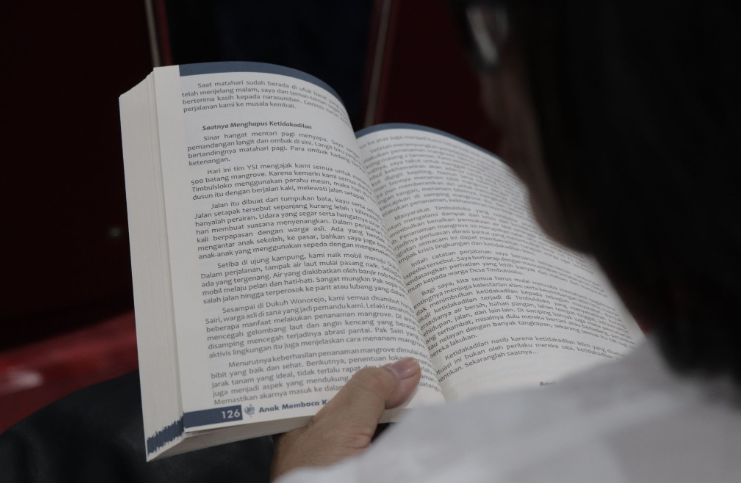
YOGYAKARTA – Yayasan SHEEP Indonesia (YSI) launched and held a book discussion for Children Reading Climate Justice as part of its Climate Festival, an initiative aimed at strengthening climate literacy while expanding opportunities for children to participate in raising awareness about climate change. The book is a collection of writings by students from schools partnering with Yayasan SHEEP Indonesia. It was developed through a learning journey during the Climate Justice Expedition in Timbulsloko Village, Demak Regency, Central Java.
Unlike most publications on climate change, Children Reading Climate Justice presents children's firsthand experiences, observations, and reflections as members of the Climate Justice Warriors after directly engaging with communities living with recurring tidal flooding. Through dozens of personal stories, readers are invited to understand that the climate crisis is not merely about rising global temperatures or environmental degradation. It is also about people's lives, livelihoods, and their fundamental right to live with dignity.
Learning Directly from Climate-Affected Communities
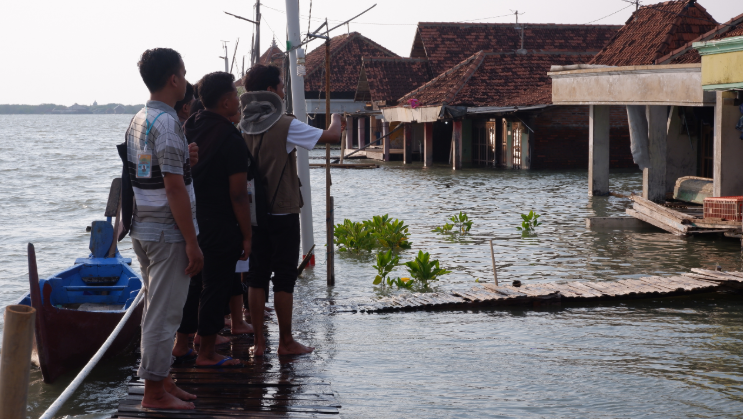
Every story in the book emerged from the participants' experiences during the Climate Justice Expedition organized by Yayasan SHEEP Indonesia. Over the course of two days, the students stayed with families in Timbulsloko Village, conducted observations and interviews, engaged in discussions with local residents, and documented the changes brought about by increasingly severe tidal flooding.
One of the most recurring stories in the book tells of the transformation of Timbulsloko Village. Mr. Sobirin, a respected community leader, recalled how the village was once a fertile agricultural area before tidal flooding dramatically changed the lives of its residents.
"Before the year 2000, Timbulsloko was a prosperous and fertile place, often described as a paradise on earth. The land was incredibly productive. However, between 2010 and 2017, as tidal flooding became increasingly severe, the land could no longer be cultivated effectively. Our lives changed completely."
Through stories like this, the young authors came to understand that those who suffer the greatest impacts of climate change are often not the ones primarily responsible for causing environmental degradation. This realization became the central theme running throughout the book.
Witnessing Resilience Amid Challenges
While documenting the impacts of the climate crisis, the book also highlights the resilience of local communities in the face of ongoing hardship. The students describe how residents continue their daily lives despite persistent flooding, limited transportation, and changing livelihoods caused by the loss of agricultural land and fishponds.
Despite these challenges, the community's spirit remains strong. Mr. Sobirin concluded his story with a message of hope.
"We believe that every hardship carries a valuable lesson."
For the young writers, meeting the people of Timbulsloko was far more than a field visit. The experience transformed their understanding of resilience, mutual cooperation, and the importance of protecting the environment to prevent similar crises from spreading further.
Building Awareness Through Writing
Each story in the book reflects a unique perspective on climate justice. Some students write about their journey to a village submerged by tidal flooding. Others share stories of residents who lost their livelihoods, while some focus on the experiences of children growing up under the constant threat of climate change.
These writings not only document the realities they witnessed but also raise profound questions about justice. Why are communities living in harmony with nature often the ones who bear the greatest burden of environmental destruction? Why should children lose safe spaces to play, a sense of security, and opportunities for a better future because of a crisis they did not create? These questions emerge repeatedly throughout the book, inviting readers to reflect more deeply on the human dimensions of climate change.
At the same time, the book highlights inspiring examples of community adaptation, including the construction of wooden bridges, the conservation of mangrove forests as natural coastal protection, and the strengthening of social solidarity to help communities adapt to ongoing environmental changes.
Amplifying Children's Voices in the Climate Justice Movement
Through Children Reading Climate Justice, Yayasan SHEEP Indonesia demonstrates that children are capable of observing, reflecting upon, and expressing environmental issues through their own writing. The book shows that climate education should extend beyond classroom theory by providing meaningful learning experiences that enable children to witness realities firsthand, engage directly with affected communities, and develop their own perspectives based on those experiences.
More than simply a collection of stories, Children Reading Climate Justice serves as a record of a shared learning journey and a call for more people to listen to children's voices in addressing the climate crisis. Through simple yet deeply meaningful narratives, these young authors remind us that protecting the planet is a shared responsibility, and that climate justice can only be achieved when no community is left to face the impacts of climate change alone.
Source: Children Reading Climate Justice